Where Deals Get Done in Waders: Inside the South's Most Powerful Informal Boardrooms
You won't find this meeting on any calendar. There's no agenda, no slide deck, no catered lunch from a hotel ballroom. But somewhere deep in the Georgia pines, or along a Mississippi Delta oxbow lake, or tucked into the Tennessee hill country, a deal is being made right now — and it'll stick harder than anything signed in a downtown high-rise.
The Southern hunting camp and fishing lodge have always been more than places to chase whitetail or pull bass out of murky water. For generations, they've served as the region's most powerful — and least discussed — informal boardrooms. And if you've never had a seat at that table, you might not even know the table exists.
The Unwritten Invitation List
Getting invited to the right camp is its own kind of credential. These aren't open-enrollment retreats. Membership — whether it's a formal hunting club with dues and bylaws or just a cousin's back forty that's been used since the Eisenhower administration — is extended carefully and deliberately. You don't ask to come. You get asked.
That selectivity is part of the point. When a banker from Birmingham and a contractor from Tuscaloosa have been hunting the same stretch of land for fifteen years, there's a shorthand between them that no amount of conference room time can replicate. They've seen each other cold, tired, frustrated, and generous. They know who picks up the tab without being asked and who conveniently disappears when it's time to clean the cooler. Character, in the camp setting, is impossible to fake for long.
"You learn more about a man in three days at deer camp than you do in three years of lunch meetings," says one Alabama-based commercial real estate developer who asked not to be named — which itself tells you something about how seriously these circles take their privacy. "I've turned down business partners based on how they acted around a campfire. And I've taken on partners I never would've considered otherwise, for the same reason."
Rituals That Run the Room
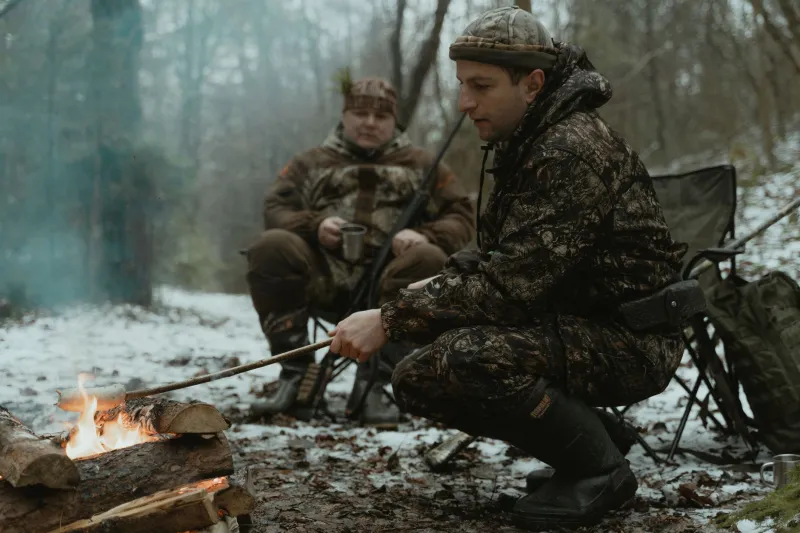
Every camp has its own culture, but certain rituals show up with enough consistency to feel almost universal. There's the arrival bourbon — whatever bottle someone brought, poured generous and early. There's the meal prep hierarchy, where the person who's been coming longest has quiet authority over the cast iron. There's the debrief after the morning hunt, where stories get told and retold until they're half myth.
And then there's the talk that doesn't announce itself as talk. Business doesn't get brought up the way it does in an office. It slides in sideways — a mention of a project over supper, a question about financing while someone's cleaning a rifle, a handshake after breakfast that nobody else in the cabin fully registers. The informality isn't accidental. It's the whole mechanism.
In the South, trust has always been relational before it's transactional. The camp accelerates that relational timeline in a way that no amount of golf or corporate retreats can quite match. You're sharing space, sharing food, sharing silence. The walls come down fast when you're both standing in the same cold creek at six in the morning.
The Hierarchy Nobody Talks About
For all the camaraderie, there is a pecking order — it's just unspoken. The elder who's been coming to a particular camp since before anyone else was born carries a weight that doesn't need a title. His opinion on a deal, offered casually over a cup of coffee, lands differently than anyone else's. His blessing — even implicit — can open doors. His skepticism can quietly close them.
This is where values get transmitted, too. The old-timer who insists on fair dealing, who tells a younger member to give a vendor a better price because "that's how we do," is doing something that no compliance training ever could. He's modeling a code. And the younger men — and increasingly, younger women — who earn their way into these spaces absorb that code whether they realize it or not.
Women at the Camp
The demographic is shifting, slowly but meaningfully. More women are hunting and fishing across the South than at any point in recent memory, and with them come new dynamics in these traditionally male-dominated spaces. Some camps have integrated organically, daughters taking over spots their fathers once held. Others have formed their own networks — women's hunting clubs and fishing groups that function with the same relational logic as their older counterparts.
"The business conversations happen exactly the same way," says a woman who co-owns a hunting lease in East Texas with a group that's roughly half women now. "You're out there together, you're working hard, you're sharing meals. The trust builds the same. The deals follow the same way."
What's notable is that the core mechanism — relationship first, transaction second — doesn't change with the gender composition. If anything, it reinforces how deeply Southern that instinct runs, regardless of who's holding the fishing rod.
What the Corporate World Can't Copy
There's been no shortage of attempts to bottle this formula. Corporate retreats, team-building weekends, curated "authentic experiences" sold to executives looking for that elusive trust-building magic — they all gesture at something real without quite landing it. The difference is that the hunting camp isn't performing authenticity. It is authentic, accumulated over decades, rooted in place and season and shared history.
You can't replicate the fact that somebody's grandfather built that cabin. You can't manufacture the ritual of the same group returning to the same land every November for forty years. The weight of that continuity is exactly what gives these spaces their power — and why the conversations that happen inside them carry a gravity that a hotel conference room simply cannot compete with.
The South's Quietest Power Grid
If you want to understand how influence actually moves through the South — how decisions get made, how networks form, how reputations get built or quietly buried — you have to look past the chambers of commerce and the charity galas and the formal business associations. Follow the pickup trucks down the dirt road. Follow the smell of woodsmoke and bourbon.
The real boardroom has a firepit and a cooler. The minutes aren't kept. The agreements aren't always written down. But they hold — because in the South, your word given in a place like that is worth more than anything you'll ever sign in an office. And everybody who matters already knows it.