Sittin' a Spell: Why the Southern Front Porch Is Still the Most Powerful Square Footage in the Neighborhood
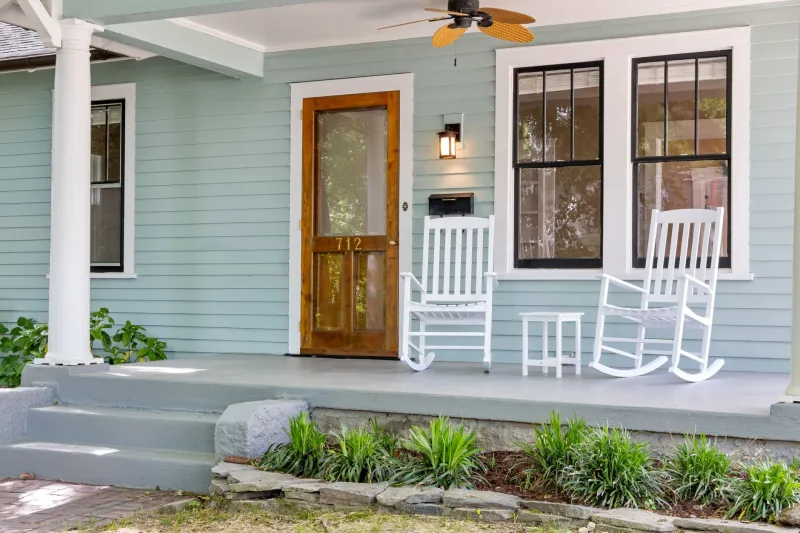
There's a particular kind of magic that happens when two rocking chairs face the street and somebody pours a glass of sweet tea. Conversations start slow — weather, somebody's new truck, how the garden's doing — and then, almost without warning, you're deep into something real. A neighbor's zoning concern. A plan to fix the flooding on the back road. A decision about whether to throw a block party or finally address that abandoned lot on the corner.
This is porch politics. And in the South, it's been the original community operating system for a very long time.
More Than a Porch, It's a Philosophy
The front porch isn't just a structural feature of Southern homes — it's a cultural statement. It says: I'm here. Come talk to me. Unlike the backyard, which signals privacy, the front porch is deliberately public-facing. It sits between the intimate world of the home and the wider life of the street, and that in-between space turns out to be incredibly fertile ground for community.
Historian and Atlanta-based cultural critic Dr. Lavonne Treadwell has spent years studying how Southern spatial design shaped social behavior. "The front porch was intentional," she explains. "In a pre-air-conditioning South, it was practical. But it also created a daily ritual of visibility. You saw your neighbors. They saw you. That visibility built accountability, and accountability built community."
That accountability wasn't always comfortable — gossip has always been part of the porch tradition too, and not all of it kind. But even that served a social function. The porch was a place where community norms got negotiated out loud, where reputations were built and questioned, where the unwritten rules of a neighborhood got reinforced or challenged.
Where Real Decisions Actually Got Made
Ask anyone who grew up in a small Southern town and they'll tell you: the real decisions didn't happen in the city council chambers. They happened on porches.
In communities across Mississippi, Georgia, Alabama, and the Carolinas, front porches functioned as informal civic spaces long before formal community organizations existed. Neighbors coordinated disaster relief after storms, organized food drives, debated school board candidates, and hashed out property disputes — all over the railings and steps of somebody's front porch.
Reverend Marcus Holloway, a community organizer in Birmingham who grew up in rural Coosa County, remembers it vividly. "My grandmother's porch was where everything happened. If somebody needed help, word spread from that porch. If there was a problem in the community, somebody would end up on that porch talking it through. It wasn't a meeting. It was just life. But things got decided."
That organic, low-barrier form of civic engagement is something political scientists and urban planners spend a lot of time trying to recreate artificially. The porch did it naturally, every evening, for free.
The Quiet Threat: When Design Kills Community
So what happened? Drive through any newer subdivision in suburban Nashville, Charlotte, or Houston and you'll notice something missing. The homes face inward. Garages dominate the street-facing facade. Backyards are fenced and private. Front porches, where they exist at all, are decorative — too small to actually sit on, too close to the garage door to feel welcoming.
This isn't accidental. Post-WWII suburban development prioritized the automobile and the private family unit over neighborly interaction. Air conditioning made the porch optional. Busy schedules made lingering feel like a luxury. And somewhere along the way, the front porch went from being the living room of the neighborhood to being a place to leave your Amazon packages.
Urban planner Deja Simmons, who works with community development organizations across the Southeast, calls it "the privatization of public life at the neighborhood scale." She argues that the disappearance of the front porch isn't just an aesthetic loss — it's a civic one. "When you remove the casual, everyday spaces where neighbors interact, you don't just lose conversation. You lose trust. And when you lose trust, community decisions get harder to make."
The data backs her up. Studies on social capital consistently show that neighborhoods with higher rates of casual neighbor interaction — the kind that happens on porches and front stoops — report stronger community cohesion and higher civic participation.
Reclaiming the Boards
But here's the good news: folks are fighting back, and they're doing it the Southern way — one porch at a time.
Across the region, community groups and neighborhood associations are actively working to bring porch culture back. In New Orleans, the Front Porch Coalition has been hosting neighborhood porch nights for years, encouraging residents to simply sit outside and be available to their neighbors. In Asheville, North Carolina, local architects are advocating for zoning changes that incentivize front porch construction in new developments. In small towns from Natchez to Knoxville, community leaders are hosting "porch talks" — structured but informal conversations held on actual porches — as an alternative to sterile town hall meetings.
Reverend Holloway has taken this approach in Birmingham. "We started doing community listening sessions on people's actual porches instead of in church basements or rec centers. The difference in how people talked was immediate. People were more honest. More relaxed. More willing to actually listen."
There's something to that. The porch lowers the stakes. It's not a formal proceeding. There's no podium, no agenda, no Roberts' Rules of Order. It's just people, a shared space, and the understanding that nobody's going anywhere for a little while.
The Porch as a Southern Superpower
What makes this particularly Southern isn't just the architecture — it's the value system behind it. The South has always placed a premium on hospitality, on the idea that your home extends outward toward the people around you. The porch is the physical expression of that value. It's the handshake between private life and public community.
And in a moment when American civic life feels more fractured than ever — when neighbors often don't know each other's names, when community decisions get made in comment sections and Nextdoor threads instead of face-to-face — that Southern tradition of the front porch starts to look less like nostalgia and more like a genuine model worth preserving.
So if you've got a porch, use it. Pull up a chair. Wave at somebody walking by. Let the conversation go wherever it goes. You might just end up solving something.
Or at the very least, you'll have a real good time trying.