Pass the Dish: How the Church Potluck Became the South's Most Powerful Social Institution
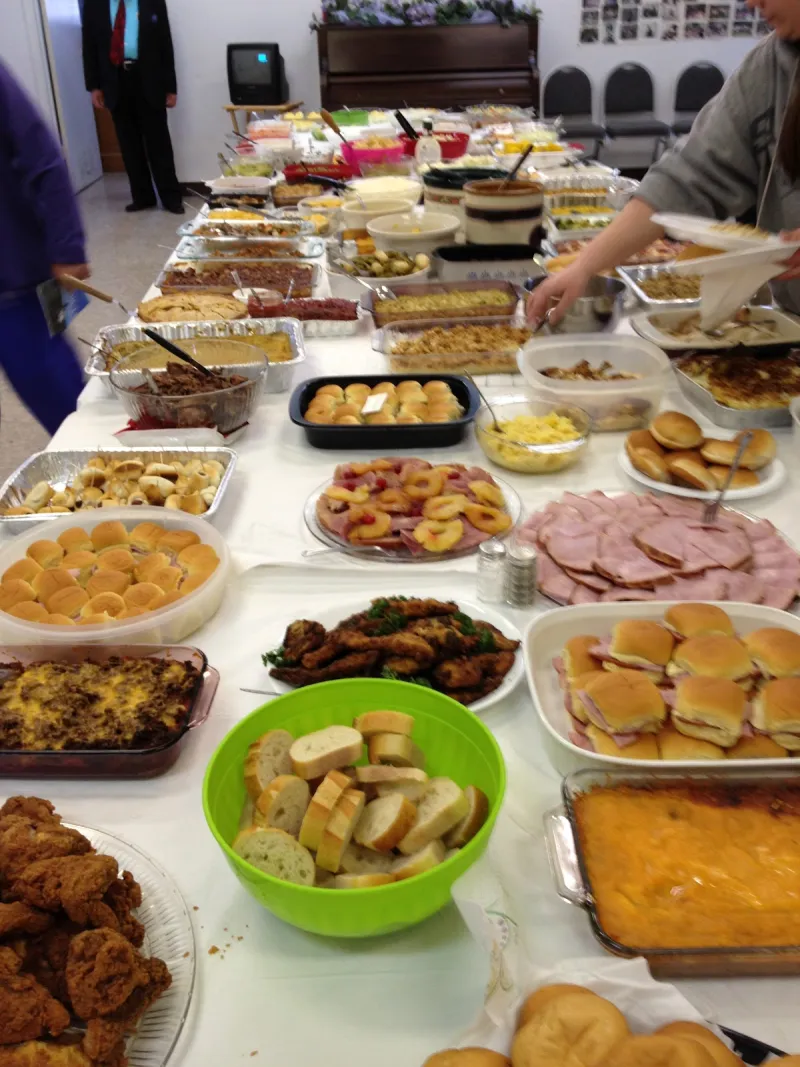
Photo: Southern church potluck covered dish dinner fellowship hall community meal, via blogger.googleusercontent.com
Somewhere in the South right now, a woman is pulling a casserole dish out of the oven, wrapping it in a dish towel, and loading it into the back seat of her car. A man is slicing a pound cake he's been up since six o'clock to bake. A teenager is grudgingly carrying a gallon of sweet tea to the fellowship hall. And within the hour, a hundred people who might not otherwise cross paths this week will be standing shoulder to shoulder, filling their plates and catching up on each other's lives.
This is the church potluck. It has no marketing team, no app, no algorithm pushing it to your feed. It runs on casserole dishes, folding tables, and the deeply Southern conviction that food is how you show up for people. And it might be one of the most effective community-building tools ever invented.
A Tradition Older Than the South Itself
The covered dish dinner — called a "potluck" in some places, a "dinner on the grounds" in others — is older than the region's modern identity. Early American settler communities, many of whom had roots in the British Isles and Western Africa, brought with them traditions of communal eating tied to religious and seasonal gatherings. In the rural South, where distances between neighbors could be significant and resources often stretched thin, these gatherings took on an outsized social importance.
Church was frequently the only institution that reliably brought a community together. And food was the great equalizer at the table. The deacon's wife and the sharecropper's family were eating from the same spread. Somebody's cornbread sat next to somebody else's deviled eggs, and the combination was always better than either alone.
For Black Southern communities in particular, the church supper held a significance that went well beyond the meal itself. During Jim Crow, the church was often the only truly autonomous space — a place where Black Southerners could gather, organize, celebrate, and grieve on their own terms. The food shared at those tables was an act of community sovereignty as much as it was hospitality.
What's Actually on That Table
Let's talk about the food for a second, because it deserves its own moment.
A proper Southern church potluck is a study in regional specificity. In coastal Georgia and the Lowcountry of South Carolina, you're likely to find a Frogmore stew or a pot of perloo. In East Tennessee, stack cake — a dense, many-layered dessert made with dried apple filling — might appear alongside a pot of pinto beans. In Louisiana, there's a solid chance someone has brought a pot of red beans and rice or a pan of boudin, and there will absolutely be a debate about whose version is better.
But there are constants across the South: fried chicken that makes the store-bought version feel like a personal insult. Macaroni and cheese that is a main course, not a side dish, and don't let anyone tell you otherwise. Deviled eggs that disappear before the prayer is even finished. Banana pudding made with real vanilla wafers, layered by someone who takes this seriously.
The food carries memory. A specific dish can connect a room full of people to a shared history in a way that no speech or ceremony quite manages. When Miss Ernestine brings her sweet potato pie, she brings with her every version of that pie going back through her mother and her grandmother. That's not nothing. That's everything.
The Social Architecture of a Potluck
Here's what a church potluck actually does, functionally, for a community — and why it works so well.
First, it requires participation. Unlike a catered event or a restaurant dinner, a potluck demands contribution. You bring something. That act of bringing — of putting your time and your resources and often your family's recipe into a dish — creates a sense of investment. You're not just a guest. You're a contributor. The distinction matters more than it sounds.
Second, it creates a low-stakes reason to show up. Mental health researchers and sociologists have spent a lot of time in recent years trying to understand the epidemic of loneliness in America. One of the consistent findings is that people need what researchers call "third places" — spaces that are neither home nor work, where casual social interaction happens naturally. The fellowship hall after Sunday service is, functionally, a perfect third place. You don't have to perform wellness or make small talk in the way networking events demand. You just show up, fill your plate, and sit down somewhere.
Third, it transmits culture across generations in real time. When a twelve-year-old watches her great-aunt explain why you have to add the milk slowly to the gravy, she's receiving cultural education that no classroom can replicate. When the older members of a congregation share a meal with the younger ones, they're not just eating together — they're passing something down.
What Isolation Is Costing Us
The surgeon general of the United States declared loneliness a public health epidemic in 2023. The numbers behind that declaration are genuinely alarming: roughly half of American adults report measurable levels of loneliness, and the health consequences — elevated risk of heart disease, cognitive decline, depression — are comparable to smoking half a pack of cigarettes a day.
The South is not immune to this. Rural communities have been hit especially hard by the decline of the institutions that once held them together. Churches in small towns are closing or consolidating. The fellowship hall sits empty more often than it used to. The covered dish dinners happen less frequently, and when they do, the generations aren't mixing the way they once did.
This is a real loss. Not just a sentimental one.
Bringing It Back — Or Just Showing Up
The good news is that the potluck, as a concept, doesn't require a church. It doesn't require a formal institution of any kind. It requires a table, a willingness to cook something and bring it, and the decision to make space for people.
Across the South, there's a quiet revival happening. Neighborhood supper clubs. Community dinners organized by local farms and food co-ops. Cultural organizations hosting covered dish events as a way to gather people across generational and social lines. The form is flexible. The function is the same.
If you want to understand how Southern communities have survived and adapted through everything — economic hardship, social upheaval, natural disaster, pandemic — look at the table. Look at who's feeding whom, and how, and what it costs them, and what they get back. That exchange has always been at the heart of it.
Somebody pass the cornbread.